
Pain
How Long Does Tramadol 100mg Stay in Your System?
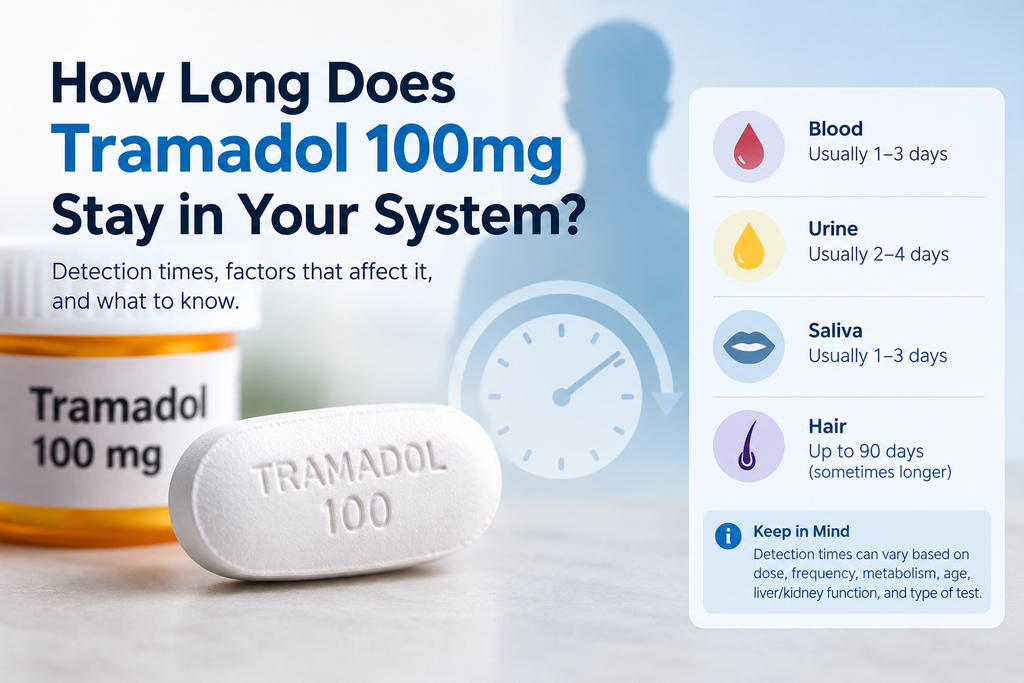
Tramadol is a common pain-relieving medication prescribed for moderate-to-severe pain. You get several brands of the opioid-based medication, including Conzip, Ultram, and Ryzolt. Painkillers, such as Tramadol, also have a half-life, which is about six to eight hours. That means the concentration or strength of these pills will be reduced by half during that time.
While most other medications survive only four or five half-lives at most, which is about a day or day-and-a-half, Tramadol can remain in your system for nearly two days, or 40 hours at most, to be specific, as it is slower-reacting. So, patients on this medication will no longer feel its effects after two days, nor will they be detectable in the saliva, although they may remain in the body fluids, hair, and breath.
Interactions and Effects of Tramadol
There is not much information regarding how tramadol interacts with the body. However, based on various studies, the pain-relieving medication possibly attaches itself to opioid receptors in the brain and nervous system to stop transmitting signals to those parts of the body that are in pain. Tramadol also increases serotonin and norepinephrine content, two neurotransmitters responsible for pain perception, to disrupt how the brain understands and responds to pain.
The pain reliever can be released in two ways. One of those methods, typically called immediate release, involves the medication immediately entering the bloodstream within an hour or so of administration. However, it can still take up to three hours for the effects to peak.
There’s also another way in which Tramadol can get into the system, called Extended Release. In this method, the medication gets into the body and acts slowly, usually after 24 hours of administering the last dose. The effects are much more robust and longer-lasting than immediate release, owing to the gradual action of the medication, and is usually meant for people experiencing severe or chronic pain.
Detecting Tramadol 100mg
While Tramadol 100mg can last in the body for up to 40 hours, at most, which is nearly two days, it also depends on various other factors, including metabolism. There are several ways to detect the drug from inside the body. Each test has a different detection window, which is the timeframe for detecting traces of Tramadol in the body and bloodstream. The window for detecting the medication in the body after taking the last dose varies depending on the specific tests conducted, which may be related to the blood, urine, saliva, or hair.
Urine
Urine tests are among the most common and accurate for detecting Tramadol, as the drug remains in the urine for at least two days after the final dose. The detection window is 72 hours or three days in most cases, making these tests not only one of the most accurate but also the most sensitive for detecting Tramadol and other opioid-based medications.
Blood
Tramadol usually remains in the bloodstream for up to two days at most, although there have been cases where it has remained for even three days after the final dose. However, blood tests for detecting pain-relieving medications like Tramadol are less common owing to their low accuracy and invasiveness.
Saliva
Painkillers, including Tramadol, can remain in saliva for up to two days, making saliva tests easier to administer. Saliva tests are also less invasive and more accurate than blood tests, so they are more commonly employed in non-clinical settings, such as workplaces.
Hair
Tramadol remains in the hair for up to 90 days, making testing and detecting the drug highly reliable and accurate compared to its saliva and blood counterparts. You also get specific results in measurements of test samples, as opposed to blood and saliva tests, which only come out as positive or negative.
Removing Tramadol
Getting Tramadol out of the bloodstream depends on several factors, including how fast your body can process the effective painkiller. However, while most people believe that they can get rid of the drug from their systems by drinking lots of water and exercising rigorously, the only way to altogether remove all traces of Tramadol is to stop taking it. That means dealing with withdrawal, which can occur within a mere eight hours to a day of the last dose.
Various other factors, including dosage, age, method of administration, and genetics, also vastly influence how long the potential pain-relieving medication stays in the body.
Dosage
Dosage is key to determining how long Tramadol stays inside the body. While your body may take longer to eliminate higher doses of the medication, it also depends on your liver since the enzymes present in this vital organ are responsible for the metabolization. The same goes for detecting Tramadol, which usually takes longer for larger doses, especially the extended-release forms of the medication.
Age
Metabolism processes tend to slow down with age, and it may take more time for individuals on Tramadol, especially those over 65, to get the medication out. This could also be related to liver and kidney functioning, which is vital to metabolism.
Administration
How Tramadol is administered also plays a crucial role in its detection and removal. It may take more time to get tablet forms of the medication out. When you weigh that out against injections, these usually take less time to come out, as they can get into the bloodstream quicker than the pills. However, detecting external-release tablets becomes easier, as these take more time to get into the bloodstream, giving a more prolonged detection window.
Genetics
Genetic factors may also affect how your body processes substances like Tramadol. Specific enzymes help metabolize the medication, and in some people, these enzymes may be slow, meaning that the drug breaks down slowly and may stay put in the system. The enzyme that can metabolize Tramadol, called CYP2D6, generally contains ultra-fast metabolizers capable of rapidly breaking down the medication. However, metabolizers are slower than usual for those with genetically modified versions of this enzyme, and the process can take longer.
Other Medications and Substances
Several medications and substances like alcohol can alter metabolism rates. For instance, some SSRI and SSNI antidepressants have the potential to slow down the metabolic processes related to Tramadol, whereas other medications, such as anticonvulsants, can help speed up metabolism.
Getting Help
Those on Tramadol can experience both dependence and withdrawal symptoms, with withdrawal occurring as early as within a day and peaking in three days. The first visible signs are anxiety, chills, restlessness, sweating, runny noses, watery eyes, and muscle and joint aches. The peak phase is the most intense and uncomfortable, where patients can experience nausea, vomiting, diarrhea, stomach cramps, insomnia, sweating, tremors, and increased heart rates and blood pressure levels. However, withdrawal symptoms usually tend to decline and disappear within two weeks, during which they are primarily psychological. These symptoms may manifest as fatigue, depression, anxiety, sleeplessness, and a craving for Tramadol and other opioid-based substances.
In any case, those with Tramadol dependency or withdrawal must get help immediately before the condition worsens. So, you might want to consult your neighborhood doctor as soon as you can if you notice signs of dependence or withdrawal after being on the medication.
Leave a Reply